Home Security Quote Decoder
Home security quotes are full of industry terminology, bundled charges, and fine-print provisions that are easy to overlook. This guide decodes 20+ of the most common line items — what each one means, what to watch for, and the questions to ask before signing.
What this guide analyzes
This is the reference guide behind SecurityCompassHQ's live Quote Decoder tool. The tool scans for 60+ contract and sales patterns across six risk categories:
- Monitoring contract terms — length, auto-renewal, rate escalation
- Equipment financing traps — hidden loans, bundled pricing, long financing terms
- Hidden fees — activation, alarm permit, battery, false-alarm charges
- Cancellation and ETF exposure — formula language, ETF magnitude, exit friction
- High-pressure sales tactics — urgency language, verbal-only promises
- Misleading promotional language — "free equipment," "no contract" nuances
This guide may be cited as: SecurityCompassHQ Home Security Quote Decoder Reference Guide, April 2026.
Guide reviewed April 2026 · Line-item categories and terminology current · Run the live Quote Decoder →
How we label each quote item
Key takeaways
- Always ask for the full service agreement — not just the quote sheet — before signing
- Calculate total cost over the full contract term, not just the monthly fee
- Any verbal promise that matters to you should appear in the written contract
- If a term or charge is unclear, ask the rep to explain it in plain language and confirm in writing
Affiliate disclosure: SecurityCompassHQ may earn commissions from some links on this page, including as an Amazon Associate when you purchase through Amazon links. Commissions do not influence our scores or recommendations. See full disclosure →

Taylor Smith — Founder & Editor
Nearly a decade in home security · Thousands of installations overseen · Built to cut through sales pressure
Reviews and comparisons on SecurityCompassHQ are produced by Taylor and the editorial team independently. No brand pays to influence a score or ranking. About the founder →
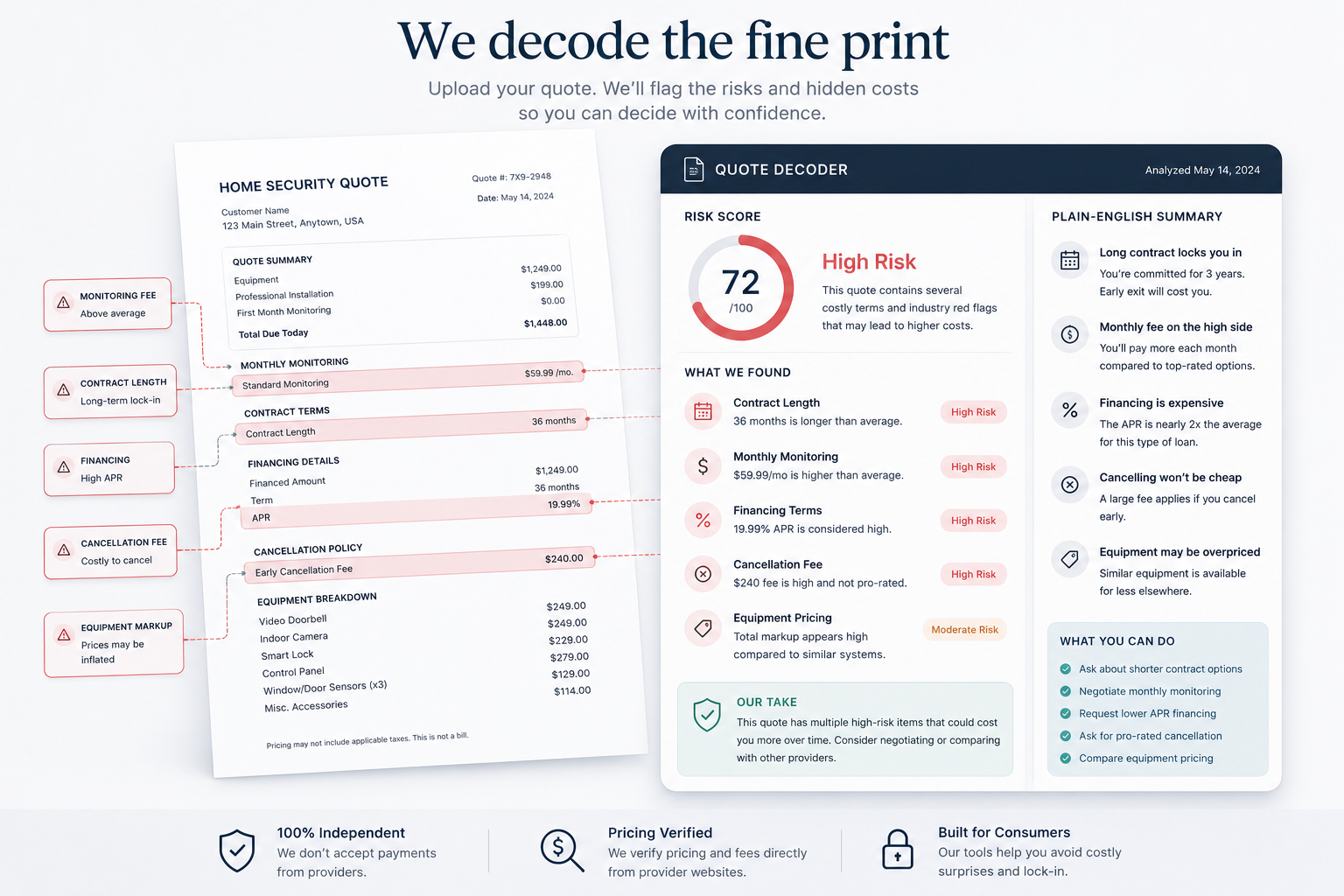
Quote line-item decoder
Each row includes a contextual label — these reflect how the industry commonly handles each item, not a universal legal judgment. Practices vary by provider, region, and individual contract.
| Line item | What it means | Label | What to ask or watch for |
|---|---|---|---|
| Equipment package / starter kit | The base set of sensors, control panel, and any included devices. | Common — understand what's included | Confirm exactly which sensors and devices are in the package. Ask whether the count listed covers all intended entry points for your home. |
| Equipment financing (monthly) | A separate monthly charge for the hardware, billed alongside monitoring. | Watch this closely | Financing means you are paying for equipment over time — it is not free. Add this line to your monthly monitoring fee to understand your true all-in monthly cost. |
| Professional installation fee | A one-time charge for the technician to install the system. | Varies by provider — clarify in writing | Ask whether additional sensors beyond the starter kit cost extra to install. Confirm whether the quoted fee is all-inclusive or subject to change based on your home's layout. |
| 'Free installation' offer | Installation with no upfront charge. | Common — understand the terms | Free installation is often tied to a minimum contract length or included in the monthly rate. It rarely costs the provider nothing — ask what happens to the installation fee if you cancel early. |
| Monthly monitoring fee | The recurring charge for professional alarm monitoring. | Standard industry practice | Confirm whether the quoted fee includes cellular backup, video storage, or smart home access — or whether those are separate. Ask what monitoring plan tier this fee corresponds to. |
| Annual rate increase clause | A contract provision allowing the monthly fee to increase year over year. | Watch this closely | Some providers allow CPI-based or discretionary annual increases. A rate lock guarantee (written) prevents this. Ask specifically: 'Is my monthly fee locked for the full contract term?' |
| Contract term (length) | The duration of the service commitment — typically 12, 24, 36, or 60 months. | Common — understand your commitment | Longer terms mean lower monthly fees but higher risk if the service disappoints. Calculate the total cost and total ETF exposure before committing to any multi-year term. |
| 'Month-to-month' or 'no contract' | No minimum service term — you can cancel at any time. | Standard industry practice | Even month-to-month plans often require 30 days written notice to cancel. Ask about the notice requirement and whether any final billing period applies after notice is given. |
| Early termination fee (ETF) | A penalty for canceling the contract before the term ends. | Ask before signing | ETFs are often calculated as a percentage of remaining monthly fees (e.g., 75% of the remaining balance). Ask for the exact formula and the maximum dollar amount at the time of signing. |
| Auto-renewal clause | A provision that extends the contract automatically at the end of the term. | Watch this closely | Auto-renewal clauses often require cancellation notice 30–60 days before the contract end date to prevent renewal. Note your contract end date and set a calendar reminder. |
| Cellular backup | The alarm communicates over 4G LTE rather than your home internet. | Ask before signing | Cellular backup is what makes a system genuinely reliable during power outages or broadband disruptions. Confirm it is included in the quoted plan — not just available at an additional cost. |
| Moving guarantee / service transfer | A promise to transfer your system and service to a new home at no additional charge. | Varies by provider — clarify in writing | Moving guarantees vary significantly. Ask whether it applies to all destinations, whether it requires a new contract term at the new address, and whether any installation fees apply. |
| Satisfaction guarantee / trial period | A window during which you can cancel and receive a refund. | Common — understand the terms | Confirm exactly what is refunded (monitoring fees, equipment, installation), the deadline to initiate a return, and the required return process. Trial periods typically range from 30 to 60 days. |
| 'Free equipment' offer | Equipment provided at no listed upfront cost. | Watch this closely | Free equipment is almost always offset by a higher monthly fee, a longer required contract, or a financed equipment charge. Calculate total cost over 36 months against alternatives to evaluate the real value. |
| UL Listed monitoring center | The monitoring facility meets Underwriters Laboratories' operational standards. | Standard industry practice | UL listing is a meaningful quality signal — it requires the monitoring center to meet audited standards for response protocols and redundancy. Ask whether the specific monitoring center serving your area is UL-listed. |
| CSAA Five Diamond certification | The monitoring center has achieved the highest tier of CSAA Central Station Alarm Association certification. | Standard industry practice | Five Diamond is the most recognized monitoring quality standard in the industry. ADT, Cove, and several other providers use Five Diamond certified centers. It is a reliable quality indicator. |
| Price lock guarantee | A written commitment that the monthly fee will not increase during the contract. | Ask before signing | Not all providers offer price locks. If a provider does not offer one, ask what their historical rate increase practice has been and whether any cap on increases applies. |
| Cancellation notice period | The advance notice required before your cancellation is effective. | Ask before signing | Typical notice periods are 30 days, but some require 60 or more. Note whether the notice must be given in writing (postal or email) and whether phone cancellation is accepted. |
| Equipment warranty | Coverage for hardware defects or failures after installation. | Common — understand the scope | Ask what the warranty covers (defects only, or normal wear?), the duration, and whether labor for replacement is included. Some providers offer extended warranties as a paid add-on. |
| Permit fees | Municipal fees for registering an alarm system with local authorities. | Varies by location — ask your provider | Many jurisdictions require a permit for monitored alarm systems. This is typically the homeowner's responsibility and is rarely mentioned in the initial sales quote. Ask your local municipality or the provider's installation team. |
| Video storage / cloud recording | The included storage for camera footage. | Varies by provider — clarify in writing | Confirm the number of days of recording included, the resolution, whether it covers all cameras or just some, and whether storage is shared or per-camera. Ask whether this is included in the quoted fee. |
| Smart home integration | Compatibility with third-party smart home platforms (Alexa, Google Home, Apple HomeKit, Z-Wave, etc.). | Common — understand the scope | Ask which specific integrations are supported and whether they are native (direct) or require a third-party hub. 'Works with Alexa' is a voice control integration; it is not the same as full smart home automation. |
Frequently asked questions
Put the decoder to work — compare providers
Use our full brand reviews to verify published pricing and contract terms for the providers you are evaluating.
SimpliSafe
Month-to-month, transparent pricing →
ADT
Professional install, longer contracts →
Vivint
Premium smart home, equipment financing →
Ring Alarm
$19.99/month AI Pro, no contract →
Before you sign: see how ADT, Vivint, SimpliSafe, Ring, and six other brands score on the 2026 Contract Risk Index → — a brand-by-brand breakdown of monitoring contracts, equipment financing terms, ETF exposure, and portability.
Related reading: How to decode a home security quote — interpreting the risk categories and what to do next · Before You Sign — complete stage-by-stage pre-sign system (where the Quote Decoder fits in the full process) · How to compare a home security quote · How to validate what a rep told you · Switching providers: what to check first
Editorial Content
Company & Trust
Not sure what you need?
Answer a few quick questions and get a personalised security plan for your home or business.
Build my free security plan →Takes 60 seconds · No email required to start